
Services
About
Service Areas


Recognizing the signs your HVAC needs replacing not just fixing can save you from a surprise breakdown on the hottest day of a Roseville summer — or the coldest night in January. Here are the key warning signs to look for:
Quick Answer: Signs You Need HVAC Replacement, Not Just a Repair
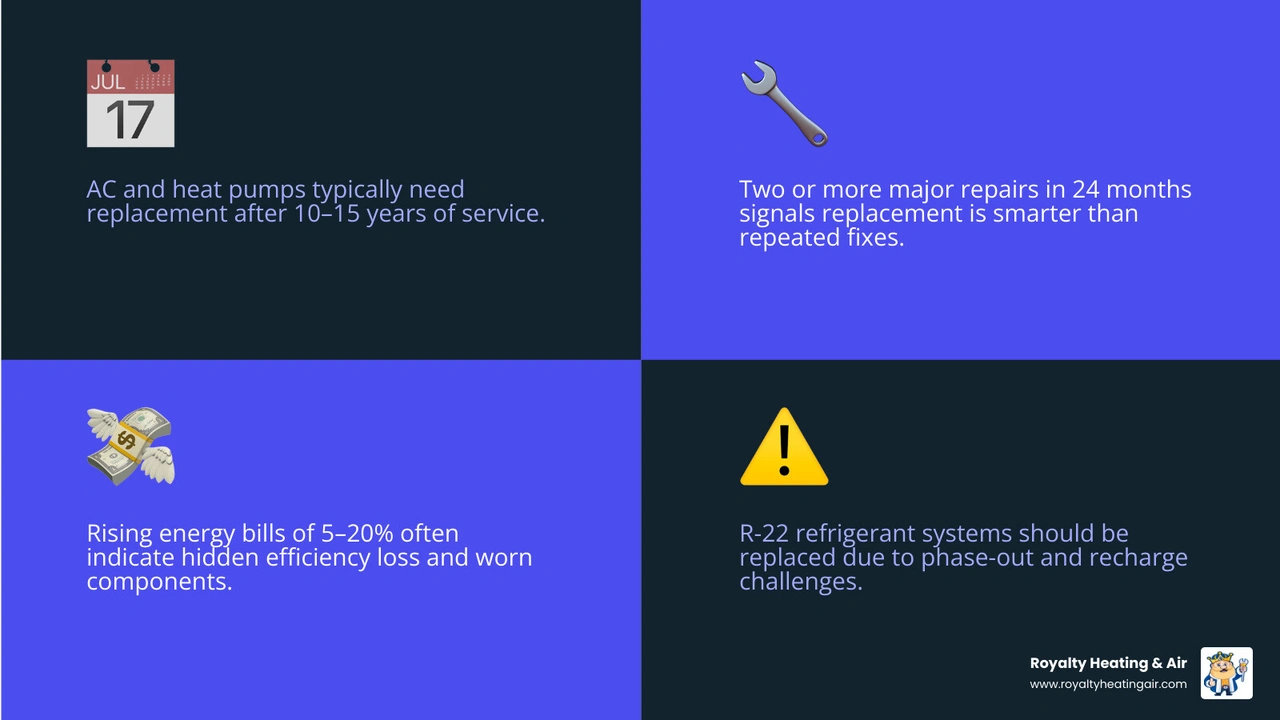
• Your system is more than 10–15 years old (10+ for AC and heat pumps, 15+ for furnaces)
• You've had two or more significant repairs in the past 24 months
• Your energy bills keep rising without a change in usage
• Some rooms are always too hot or too cold
• You hear grinding, banging, or squealing from the unit
• Your system uses R-22 refrigerant (phased out since 2020)
• You notice burning smells, gas odors, or a yellow furnace flame
• The system short cycles — starts and stops every few minutes
• Repair costs are approaching 50% of what a new system would cost
• Your home feels humid in summer or extra dry in winter
Most homeowners don't think about their HVAC system until it stops working. By then, it's often the worst possible time — peak summer heat or a freezing winter week — and the options are limited. The truth is, your system usually gives you warning signs well before it fails completely.
A system that runs but doesn't perform is still costing you money. Poor maintenance alone can drive energy use up 5–20% per year, and older systems naturally lose efficiency over time. In Roseville, where summers are long and hot, that inefficiency adds up fast.
This guide walks you through every major sign that your HVAC system has crossed the line from "needs a fix" to "needs to be replaced" — so you can make a confident, informed decision before you're forced into an emergency one.
Age is not everything, but it matters a lot. Even a well-maintained system has a service life, and once you get near the end of it, repairs often become temporary patches instead of smart long-term solutions. If you are not sure how old your system is, our guide on how old is too old for an HVAC system is a helpful place to start.
A good rule of thumb in 2026 is:
• Furnaces: about 15 to 20 years
• Central AC systems: about 10 to 15 years
• Heat pumps: about 10 to 15 years
• Boilers: about 15 to 25 years
That range depends on installation quality, maintenance history, filter changes, duct condition, and how hard the equipment has to work. A system installed correctly and maintained consistently usually lasts longer. A neglected system usually ages in dog years.
Here in Roseville, Rocklin, Lincoln, Loomis, and Granite Bay, cooling systems often work hard for long stretches of hot weather. More runtime means more wear on compressors, fan motors, capacitors, and electrical parts. Dust and debris can also reduce airflow and efficiency, especially if filters are not changed often.
Climate does not just affect AC equipment. Heating systems may not run as constantly as they do in colder regions, but they still age from normal wear, start-stop cycles, and deferred maintenance.
We start leaning toward replacement when:
• An AC or heat pump is past 10 years and having repeat problems
• A furnace is 15 years or older and losing reliability
• Parts are becoming harder to source
• The system is showing efficiency decline and comfort complaints together
Age alone does not automatically mean replacement. But age plus rising bills, repeat repairs, and uneven comfort usually does.
If your HVAC system has become a regular on your calendar, that is not a great sign. One repair now and then is normal. Repeated service calls are different. At some point, ongoing repairs on an aging system may no longer be the best long-term solution.
For a full system check, an HVAC system evaluation can help clarify whether repair still makes sense.
There is no magic number, but these are strong warning signs:
• Two or more significant repairs in the last 24 months
• Breakdowns in both heating and cooling seasons
• Repeat refrigerant leaks
• Compressor-related problems
• Major furnace issues such as heat exchanger concerns
• The same symptom keeps coming back after repair
If you are repairing an older system again and again, the issue is often broader wear, not one isolated part.
Homeowners often want a simple way to think about the decision.
Age matters here too. A moderate repair on a newer unit may be worth it. The same repair on a system near the end of its lifespan may just buy a little time.
• System age — Repair may make sense: Under 10 years — Replacement is more likely: Over 10 to 15+ years depending on type
• Repair history — Repair may make sense: Rare repairs — Replacement is more likely: Repeated repairs in recent years
• Repair size — Repair may make sense: Minor issue — Replacement is more likely: Major component failure
• Energy bills — Repair may make sense: Stable — Replacement is more likely: Rising without usage change
• Refrigerant — Repair may make sense: Current refrigerant — Replacement is more likely: Uses R-22
• Comfort — Repair may make sense: Generally good — Replacement is more likely: Ongoing hot/cold spots or humidity issues
If your thermostat habits have not changed but your utility bills keep climbing, your HVAC system may be losing efficiency. Poor maintenance alone can increase energy use by 5% to 20% over time. Worn motors, dirty coils, low refrigerant, failing sensors, and long runtimes all push energy use upward.
Older systems also lose efficiency naturally. A unit that once cooled well may now run longer for worse results. Properly installed ENERGY STAR high-efficiency units can help reduce heating and cooling energy use over time.
We believe strongly in maintenance. Preventive maintenance programs can reduce breakdowns significantly and help systems run more reliably. But maintenance is not immortality.
Tune-ups help systems last longer, run cleaner, and avoid many failures. They do not stop age, metal fatigue, compressor wear, or obsolete parts. Think of maintenance like sunscreen: very helpful, not magical.
Sometimes the clearest sign is not a dramatic breakdown. It is that your house just never feels right anymore. If comfort problems are ongoing, and especially if repairs have not solved them, replacement may be the better answer.
For deeper reading, see our AC unit replacement complete guide and heat pump replacement guide for Granite Bay, CA.
If one room feels like July and another feels like January, something is off. Temperature differences of more than about 3 to 5 degrees between rooms often point to a real HVAC or airflow issue.
Possible causes include:
• Aging equipment that cannot keep up
• Incorrect system sizing
• Thermostat mismatch
• Poor duct design
• Inadequate insulation
• A single-zone system trying to serve a changed home layout
An oversized unit can short cycle and leave rooms uneven. An undersized unit can run forever and still struggle. Neither is fun.
Weak airflow can come from a clogged filter or blocked vent, but it can also signal blower problems, duct restrictions, or a system that is simply worn out.
Ductwork matters too. Leaky or poorly sealed ducts can let up to 30% of conditioned air escape before it reaches the room. So if the bedrooms at the end of the hall never seem comfortable, the equipment may not be the only issue. A full evaluation should look at both the unit and the duct system.
Your HVAC system does more than heat and cool. It also helps manage moisture and indoor air quality.
Warning signs include:
• Sticky indoor air in summer
• Extra-dry air in winter
• Musty odors
• More dust than usual
• Allergy flareups indoors
• Persistent stale air
An older AC that no longer dehumidifies well may still produce cool air, but that does not mean it is performing properly. Likewise, excess dust may be tied to airflow issues or leaky ducts pulling particles from attics, crawl spaces, or other areas.
Sometimes the system is not broken. It is just wrong for the home you have now.
Common examples:
• Added a room or converted a garage
• Opened walls for a remodel
• Created a home office that stays occupied all day
• Increased household size
• Changed how often certain rooms are used
A system sized for your original floor plan may not be sized correctly anymore. In those cases, replacement paired with a load calculation can solve comfort issues that repairs never will.
Unusual sounds and smells are your HVAC system's way of saying, "Please stop pretending this is normal." Some issues are repairable. Others are signs the equipment is reaching the end of the road.
You can also review our AC unit replacement guide 2025 and indicators it is time for furnace replacement.
These sounds deserve attention:
• Grinding
• Banging
• Screeching
• Rattling
• Squealing
• Loud buzzing
They can point to worn bearings, loose components, blower issues, compressor wear, or metal fatigue. A single loose panel is one thing. Persistent mechanical noise from an older system is another.
Some odors are minor. Others are not.
Pay attention to:
• Burning smell
• Electrical or melting smell
• Musty or moldy odor
• Gas smell
• Acrid smoke-like smell
A musty odor may point to drainage or mold issues. A burning smell may suggest overheating parts. A gas smell is never a wait-and-see situation. Turn the system off and have it checked right away.
Short cycling means the system turns on and off too often, sometimes every few minutes. That can happen because of:
• Oversized equipment
• Sensor problems
• Overheating
• Compressor trouble
• Thermostat issues
Short cycling is hard on components and bad for comfort. It also wastes energy. If it is happening on an aging system, replacement often becomes the smarter long-term option.
If your AC or heat pump uses R-22 refrigerant, replacement is often the practical move. R-22 was phased out in the U.S. starting in 2020, which makes it harder to obtain and more difficult to justify investing in an older system that depends on it.
Many pre-2010 cooling systems may use R-22. If that system develops a refrigerant leak, continued repair may not make financial or practical sense. In most cases, planning for replacement is the better path.
Some HVAC problems are not just annoying or expensive. They can be unsafe. When safety enters the picture, replacement often moves from "worth considering" to "needs immediate professional evaluation."
If you are unsure whether a situation is urgent, read when an HVAC failure is a true emergency.
Call for professional help right away if you notice:
• Gas odors
• Yellow furnace burner flame instead of blue
• Repeated breaker trips
• Burning wire smell
• Smoke smell
• Signs of a cracked heat exchanger
• Scorching, sparking, or visible overheating
A yellow furnace flame can indicate incomplete combustion. A cracked heat exchanger can create carbon monoxide risk. These are not DIY issues and not "maybe next week" issues.
Waiting until total failure sounds simple, but it usually means:
• No heating or cooling during extreme weather
• More household disruption
• Fewer scheduling options
• Rushed decisions
• Greater chance of emergency replacement stress
Planned replacement gives you time to compare options, evaluate system sizing, and schedule installation before your home turns into a sauna or an icebox.
Replacing before a full failure can give you:
• Lower energy use
• Better temperature control
• Improved humidity management
• Quieter operation
• Cleaner indoor air
• Fewer breakdowns
• Better smart thermostat compatibility
Modern high-efficiency systems can make a noticeable difference in comfort. For example, correctly installed ENERGY STAR equipment can save up to 20% on heating and cooling costs. Newer heat pump control technology can also reduce electricity use by about 20% in the right application.
A real replacement recommendation should not be based on age alone. It should include:
• Equipment age check
• Repair history review
• Airflow testing
• Duct inspection
• Thermostat performance check
• Refrigerant and coil assessment
• Safety inspection
• Load calculation for the home
That matters even more in Roseville-area homes that have had additions, remodels, or occupancy changes over the years.
The biggest signs your HVAC needs replacing not just fixing usually show up as a pattern, not a single symptom. Age, repeat repairs, rising bills, uneven comfort, strange noises, humidity issues, outdated refrigerant, and safety concerns all point toward the same conclusion: your system may be wearing out, not just acting up.
The good news is that you do not have to guess. A professional evaluation can tell you whether a repair is still worthwhile or whether replacement would bring better comfort, efficiency, and peace of mind.
If your system is showing these warning signs in Roseville, Rocklin, Lincoln, Loomis, or Granite Bay, Royalty Heating & Air can help you make a smart plan before an emergency forces the decision. Explore more info about our services.

