
Services
About
Service Areas


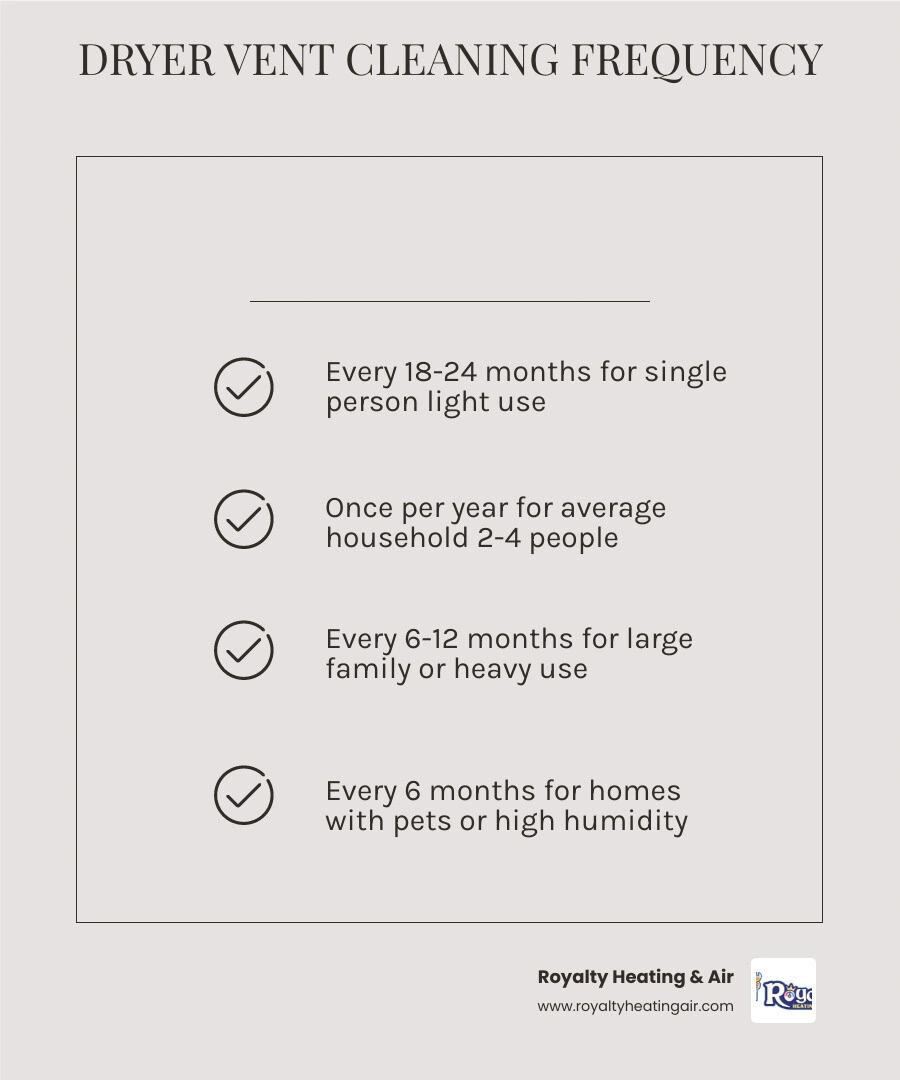
How often should you have your dryer vent cleaned depends on your household, but here is a quick answer before we dive deeper:
• Single person, light use — Recommended Cleaning Frequency: Every 18-24 months
• Average household (2-4 people) — Recommended Cleaning Frequency: Once per year
• Large family (5+ people) or heavy use — Recommended Cleaning Frequency: Every 6-12 months
• Homes with pets — Recommended Cleaning Frequency: Every 6 months
• High humidity climate — Recommended Cleaning Frequency: Every 6-12 months
Most safety organizations, including the NFPA and the U.S. Consumer Product Safety Commission, point to once every 12 months as the baseline for the average home.
That said, many households need it more often than that — and some are overdue right now without realizing it.
Here is why this matters: U.S. fire departments respond to roughly 15,000 home dryer fires every year, and failure to clean the vent is the leading cause, accounting for about one in three of those incidents. A lint filter only captures 90 to 95 percent of the lint produced each cycle. The rest travels into your vent system and builds up over time, quietly restricting airflow and creating a serious fire hazard.
A clogged dryer vent does not just raise your fire risk. It forces your dryer to work harder, drives up your energy bills, and can shorten the life of the appliance itself. A clean vent can cut energy use per load by 30 percent or more.
In the sections below, we cover every factor that affects your cleaning schedule, the warning signs you should never ignore, and how to decide between DIY maintenance and calling a professional.
Key how often should you have your dryer vent cleaned vocabulary:
• dryer vent cleaning benefits and safety
• how clogged dryer vents cause house fires
When establishing a home maintenance schedule, we always look to safety experts for the absolute baseline. According to the National Fire Protection Association (NFPA) and the U.S. Consumer Product Safety Commission (CPSC), the gold standard recommendation is to have your dryer vent system inspected and cleaned at least once every 12 months.
Think of this annual appointment the same way you think of changing the oil in your car or replacing your home's HVAC filters. It is a non-negotiable safety measure that keeps the entire system running smoothly.
However, measuring maintenance needs solely by the calendar can sometimes be misleading. A more accurate way to look at it is by usage. For the average household, a single-year cycle translates to roughly 100 to 150 drying cycles. If your household runs multiple loads of laundry every single day, you will hit that threshold much faster than a single person who only does one or two loads a week. Understanding the importance of routine vent cleaning helps prevent catastrophic failures and ensures your appliance remains code-compliant.
• 1 to 3 loads — Recommended Cleaning Interval: Every 18 to 24 months
• 4 to 7 loads (Standard) — Recommended Cleaning Interval: Every 12 months
• 8 to 10 loads — Recommended Cleaning Interval: Every 6 to 9 months
• 10+ loads (Heavy/Commercial) — Recommended Cleaning Interval: Every 3 to 6 months
By keeping track of your household’s specific laundry habits, you can accurately plan when to bring in professionals to clear out the hidden accumulation before it becomes a hazard.
No two homes are built exactly alike, which means dryer vent layouts vary wildly. Several architectural and behavioral factors dictate how quickly lint accumulates in your system.
• Vent Length and Routing: The physics of airflow are simple: the shorter and straighter the path, the easier it is for lint to escape. A short, straight vent that runs directly through an exterior wall (common in ranch-style homes) has very little surface area to trap debris. Conversely, laundry rooms located in the center of a home or on a second floor often require long, winding duct runs that snake through walls, crawlspaces, or attics.
• 90-Degree Bends: Every sharp turn in your ductwork acts as a natural speed bump for air. When warm, moist air hits a 90-degree turn, it slows down, causing suspended lint particles to drop out of the air stream and stick to the duct walls. Industry standards dictate that every 90-degree bend reduces the maximum allowable vent length (typically 35 feet) by 5 feet.
• Ductwork Material: Smooth, rigid metal ducting is the gold standard. It offers minimal resistance and gives lint very few places to catch. Flexible plastic or foil transition hoses, on the other hand, feature ribbed interiors that act like magnets for lint. Many modern building codes actually prohibit the use of flexible foil or plastic ducting behind walls due to how easily they crush, sag, and accumulate flammable debris.
If you share your home with furry companions, your dryer vent cleaning schedule needs to be accelerated. Pet hair and dander are much heavier and coarser than standard clothing fibers.
When you dry clothes, bedding, or pet blankets, hair easily bypasses the primary lint screen. While a standard lint screen captures a high percentage of clothing fibers, pet hair has a knack for slipping through the gaps. Once inside the ductwork, pet hair combines with wet lint and fabric softener residue, forming thick, felt-like mats that block airflow much faster than normal.
If you have multiple shedding pets, we highly recommend scheduling a professional cleaning every 6 months and making sure you regularly clean dryer lint trap housings to prevent immediate clogs.
Climate plays a massive, often overlooked role in how lint behaves inside your ductwork. In regions that experience high outdoor humidity, the air entering and exiting your dryer carries a heavy moisture load.
When hot, wet air from the dryer meets the humid outdoor air, condensation forms inside the cooler portions of the ductwork. This moisture makes the interior walls of your vent damp. When dry lint travels through a damp pipe, it becomes "tacky," clumping together and pasting itself to the metal walls. Instead of blowing cleanly outside, the lint builds up in thick, papier-mâché-like layers.
In humid environments, vents can clog up to two to three times faster than they would in dry climates. If you live in an area prone to high humidity, keeping a close eye on your exhaust system and choosing to clean dryer vents at least once or twice a year is essential to keep your appliance running safely.
You do not always have to wait for the calendar to tell you it is time for maintenance. Your dryer will drop obvious hints when its exhaust system is struggling. Recognizing the warning signs of clogged dryer vent systems can save you from a major breakdown or a home fire.
• Longer Drying Times: This is usually the very first red flag. If a load of towels or heavy jeans that used to take 40 minutes now requires two or three full cycles to dry completely, your vent is likely choked with lint. The moisture has nowhere to escape, leaving your clothes damp and steaming in their own humidity.
• A Hot Dryer Exterior: When a vent is clear, hot air is rapidly pushed outside. When the vent is blocked, that extreme heat backs up into the dryer drum and the cabinet of the appliance. If the top or sides of your dryer feel burning hot to the touch, or if your clothes come out with metal buttons that are too hot to handle, shut the appliance down immediately.
• A Burning Smell: If you notice a distinct, hot, scorched odor while the dryer is running, it is a sign that lint has accumulated inside the dryer chassis and is scorching near the heating element. This is an active fire hazard.
• The Dryer Shuts Off Unexpectedly: Modern dryers are equipped with thermal safety switches designed to cut power to the appliance if internal temperatures reach dangerous levels. If your dryer regularly shuts itself down mid-cycle, it is actively trying to prevent a fire.
• The Exterior Vent Flap Doesn't Open: Go outside while your dryer is running and look at the exhaust hood. The little plastic or metal flaps should be blowing wide open. If they are barely moving, fluttering weakly, or completely sealed shut, there is little to no airflow making it to the exit.
Ignoring your dryer vent is a gamble that simply isn't worth the risk. The consequences of neglected ductwork extend far beyond wet clothes.
First and foremost is the catastrophic risk of fire. Lint is composed of tiny, highly combustible fibers of cotton and polyester. When airflow is restricted, the temperature inside the dryer's heating chamber rises rapidly. If a spark or extreme heat ignites the lint accumulating inside the dryer cabinet, the fire quickly spreads into the exhaust duct. Because ducts act like chimneys, drawing in oxygen, a dryer fire can tear through walls and spread to the rest of the home in minutes. Understanding how clogged dryer vents cause house fires is the first step toward taking prevention seriously.
Beyond physical safety, there is the financial hit. A clogged vent forces your dryer to run longer and consume substantially more electricity or gas. Cleaning a clogged vent can instantly lower your monthly utility bills and protect your appliance’s delicate internal components — like the heating element and thermal fuse — from burning out prematurely.
For those with gas dryers, there is also the silent threat of carbon monoxide (CO) poisoning. If the exhaust vent is blocked, the toxic combustion byproducts of the gas burner cannot safely vent outside. Instead, they can backdraft into your laundry room, posing a severe health risk to your family. Implementing prevent dryer fires maintenance tips on a regular basis is the best way to keep your home safe, efficient, and healthy.
Many homeowners wonder if they can tackle dryer vent cleaning as a weekend DIY project. The answer depends largely on the complexity of your vent system.
If your dryer sits directly against an exterior wall and the exhaust pipe is only a foot or two long, you can easily clean it yourself. All you need to do is unplug the appliance, pull it away from the wall, disconnect the transition hose, and vacuum out the lint from both ends.
However, if your vent run is longer than 5 to 10 feet, features multiple bends, or routes through a roof or crawlspace, DIY cleaning becomes risky. Standard home improvement stores sell flexible brush kits designed to attach to power drills. While these can work for simple setups, they carry a major risk: if you push a cheap DIY brush too hard around a tight 90-degree corner, the brush head can easily detach inside the wall. When this happens, you have instantly created a massive, permanent blockage that is incredibly difficult to remove without cutting into the drywall.
Professional technicians use commercial-grade rotary brush systems powered by negative air pressure. This specialized equipment spins through the entire length of the ductwork, scrubbing the walls clean while high-powered vacuums safely collect every ounce of loosened lint without releasing it into your home. A professional can also inspect your ductwork for hidden leaks, joint separations, or crushed sections that a simple brush would miss. If you want to learn more about the complete process, our ultimate dryer vent cleaning guide breaks down exactly what a thorough, safe cleaning looks like.
Cleaning your lint trap is a daily chore, while cleaning your vent system is an annual maintenance event. Your dryer's lint screen is designed to catch the bulk of the fibers shed by your clothes during the drying cycle. It captures about 90 to 95 percent of the loose lint.
The remaining 5 to 10 percent bypasses the screen entirely, escaping into the internal dryer cabinet and traveling out into the ductwork. Over the course of a year, this small percentage accumulates into a thick, restrictive layer along the walls of your entire ventilation system. Cleaning the lint trap before every load is essential, but it does not replace the need for a comprehensive, deep clean of the ductwork.
While you might see videos online of homeowners using leaf blowers to clear out their vents, we do not recommend this method. A leaf blower relies on high-velocity air pressure to push debris out. If your vent has a heavy, compacted clog or a damp, sticky buildup of lint, the sudden blast of air from a leaf blower can actually compact the clog further, wedging it tightly into a bend or elbow.
Worse yet, if your duct joints are held together with foil tape or light screws, the extreme pressure of a leaf blower can rupture the seams inside your walls, venting hot, moist air and lint directly into your home's framing. Professional negative-air vacuum systems are always the safer, more effective choice.
A standard, professional dryer vent cleaning typically takes between 45 and 90 minutes. The process begins with a thorough visual inspection of the transition hose and the external exhaust hood. The technician will then connect specialized rotary brushes and air-whipping tools to sweep the entire length of the duct run. Finally, they will conduct an airflow velocity test to measure the backpressure and ensure your system is exhausting at peak efficiency before declaring the job complete.
Determining how often should you have your dryer vent cleaned comes down to balancing your household's size, pet situation, and local layout. While a 12-month baseline is the industry standard, paying close attention to warning signs like extended drying times or excessive heat will tell you exactly when your system needs help.
At Royalty Heating & Air, we are committed to keeping our community safe, comfortable, and energy-efficient. Our highly trained technicians serve families throughout Placer County, offering reliable dryer vent cleaning in Roseville, CA, as well as our neighboring communities in Loomis, Rocklin, Lincoln, and Granite Bay.
As a local, family-focused business, we take pride in giving back. Through our unique partnership with the MackAttack Foundation, every service we perform helps support foster babies and sponsor loving family adoptions.
If you cannot remember the last time your dryer vent was cleaned, or if your clothes are taking far too long to dry, do not wait for a hazard to develop. Contact us today to secure local dryer vent cleaning from a team you can trust, or visit our main service page to schedule professional duct services and keep your home running safely all year long.

