
Services
About
Service Areas


Inflation Reduction Act benefits for California homeowners represent one of the largest federal investments in residential energy savings in U.S. history — and as of June 2026, real money is still on the table if you know where to look.
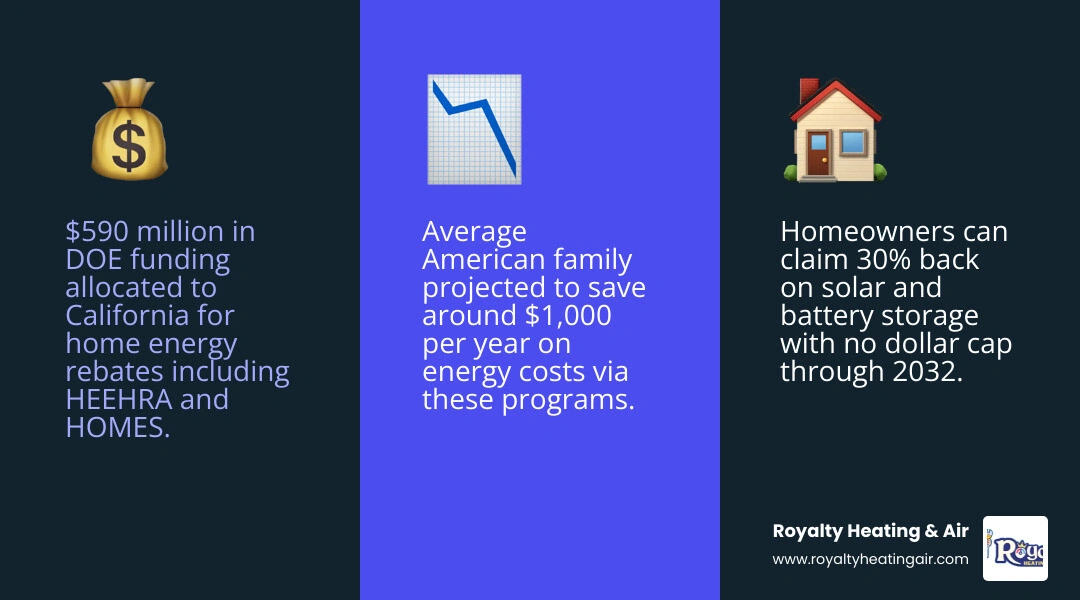
California received a total of $590 million from the U.S. Department of Energy for home energy rebates. That funding flows through three main programs:
• HEEHRA — Funding: $290 million — Who It's For: Income-qualified homeowners; heat pump rebates up to $8,000
• HOMES — Funding: $291 million — Who It's For: All income levels; whole-home efficiency upgrades
• CA-TREC — Funding: $10.3 million — Who It's For: Contractor training and program administration
On top of state rebates, federal tax credits let you claim 30% back on solar and battery storage (no dollar cap, through 2032), plus up to $3,200 per year for heat pumps, water heaters, and weatherization upgrades under the 25C credit.
The average American family is projected to save around $1,000 per year on energy costs through these programs. For California homeowners facing rising utility rates, that kind of relief is hard to ignore.
Here's the catch: HEEHRA Phase I single-family rebates were fully reserved statewide as of February 24, 2026. But that doesn't mean the opportunity is gone. Phase II funding is in development, federal tax credits remain fully available, and the HOMES program is still moving forward. Knowing which programs apply to your home — and how to access them safely — makes all the difference.
Navigating federal legislation can feel like trying to read a map in a windstorm. However, the residential energy programs established by the Inflation Reduction Act (IRA) are designed with a very clear, practical goal: to make home electrification and energy efficiency upgrades accessible and affordable for everyday families.
To make sense of the inflation reduction act benefits for california homeowners, we have to look at how the federal government allocated its massive $590 million Home Energy Rebates award to the state. The California Energy Commission (CEC) administers these funds, splitting them primarily between two major consumer-facing programs, alongside a dedicated training program for local contractors:
1. HEEHRA (Home Electrification and Appliance Rebates): This program focuses on point-of-sale discounts for specific, highly efficient electric appliances. It is heavily prioritized for low-to-moderate-income households who are transitioning away from fossil-fuel-burning systems.
2. HOMES (Home Efficiency Rebates): Unlike HEEHRA, which looks at individual appliances, the HOMES program focuses on whole-house performance. It rewards homeowners based on the measured or modeled energy savings achieved through a combination of upgrades (like pairing a new HVAC system with comprehensive insulation and air sealing).
3. CA-TREC (California Training for Residential Energy Contractors): Backed by a $10.3 million grant, this program ensures that local technicians are thoroughly trained in advanced electrification standards.
Because these programs target different goals, they operate under distinct rules. For instance, while HEEHRA rebates are strictly tied to household income, the HOMES program is open to all income levels, focusing instead on the actual percentage of energy saved. To help you visual how these programs stack up, we have broken down their core differences below:
• Primary Focus — HEEHRA (Home Electrification & Appliance Rebates): Individual appliance replacement (HVAC, water heaters, etc.) — HOMES (Home Efficiency Rebates): Whole-home energy performance & measured savings
• Income Limits — HEEHRA (Home Electrification & Appliance Rebates): Strictly LMI (Low-to-Moderate Income) households — HOMES (Home Efficiency Rebates): Open to all income levels (with higher incentives for LMI)
• Incentive Type — HEEHRA (Home Electrification & Appliance Rebates): Point-of-sale discounts applied directly by your contractor — HOMES (Home Efficiency Rebates): Rebates based on modeled or measured energy reduction
• Maximum Value — HEEHRA (Home Electrification & Appliance Rebates): Up to $8,000 for heat pump HVAC; up to $14,000 total per home — HOMES (Home Efficiency Rebates): Scaled based on performance (often up to $8,000+)
• Current Status — HEEHRA (Home Electrification & Appliance Rebates): Phase I single-family reserved; Phase II in development — HOMES (Home Efficiency Rebates): Active development; rolling out via phased pathways
If you are planning to upgrade your heating and cooling systems, understanding these distinctions is the first step toward maximizing your savings. To learn more about how state-level incentives interact with these federal programs, check out our comprehensive guide on California Energy Rebates for HVAC Upgrades.
As of June 2026, the status of HEEHRA rebates in California is in a transitional phase. When Phase I of the program launched, demand was incredibly high. Because these rebates offer substantial upfront discounts, the single-family home funding pool was fully reserved statewide by February 24, 2026.
However, this does not mean you should put your home comfort plans on hold. The California Energy Commission is actively working on the rollout of HEEHRA Phase II, which is backed by an additional $152 million in funding. When Phase II opens, it will provide fresh opportunities for single-family homeowners to secure reservations. In the meantime, working with a qualified contractor who can place you on a waitlist and help you navigate alternative funding pools is the smartest way to prepare. If you are located in the Sacramento area, understanding these regional dynamics can save you thousands; you can explore more in our guide on Heat Pump Benefits for Sacramento Area Homeowners.
To ensure that federal funds support those who need them most, HEEHRA eligibility is tied directly to your county’s Area Median Income (AMI). Your household's total income determines whether you qualify for a 50% or 100% discount on your upgrades:
• Low-Income Households (Under 80% AMI): If your household income is less than 80% of your county's median income, you qualify for 100% of the project cost to be covered by the rebate, up to the program's maximum caps (such as the $8,000 cap for a heat pump HVAC system).
• Moderate-Income Households (80% to 150% AMI): If your household income falls between 80% and 150% of the local AMI, you are eligible to have 50% of the project costs covered, up to the program caps (such as a $4,000 rebate for a heat pump HVAC system).
• Above 150% AMI: Households earning above 150% of the local median income do not qualify for HEEHRA rebates, but they remain fully eligible for federal tax credits and the HOMES performance-based rebates.
Because these rebates are applied as point-of-sale discounts, you do not have to wait until tax season to see the savings. The participating contractor deducts the rebate amount directly from your final invoice, handling the backend paperwork on your behalf.
Furthermore, while single-family funding is currently awaiting the Phase II refresh, multifamily property owners can still access significant HEEHRA benefits. Landlords of multifamily buildings where at least 50% of the residents meet the income guidelines can qualify for rebates of up to $14,000 per unit, making building-wide electrification incredibly cost-effective.
While we wait for Phase II rebate reservations to open, federal clean energy tax credits are fully active, uncapped, and ready to use today. Unlike rebates, which are upfront discounts, tax credits are claimed when you file your federal income taxes, dollar-for-dollar reducing the amount of tax you owe.
The two primary tax credits available to California homeowners are:
1. The Energy Efficient Home Improvement Credit (Section 25C): This is an annual tax credit that allows you to claim 30% of the cost of qualifying energy efficiency upgrades. Unlike older tax credits that had a lifetime limit, the 25C credit resets every single calendar year. This means you can strategically plan your upgrades over several years to maximize your tax returns.
— Heat Pumps & Heat Pump Water Heaters: You can claim up to $2,000 per year for installing qualifying heat pump HVAC systems or water heaters. To understand why this technology is so highly valued by these programs, read our detailed breakdown on How Does a Heat Pump Work.
— Electrical Panel Upgrades: If your home requires an electrical panel upgrade or advanced wiring to support your new heat pump, you can claim up to $1,200 per year for these electrical improvements.
— Weatherization: You can claim up to $1,200 per year for energy-efficient windows, doors, and insulation.
2. The Residential Clean Energy Credit (Section 25D): This credit covers 30% of the installation costs for solar photovoltaic (PV) panels, solar water heaters, and battery storage systems. It has been extended at the full 30% rate through 2032, and there is no maximum dollar limit on what you can claim.
One of the most significant updates under the Inflation Reduction Act is the treatment of home battery storage systems. Previously, battery storage only qualified for federal tax credits if it was installed alongside and charged directly by a solar panel system.
Under the current rules, standalone battery storage systems with a capacity of 3 kilowatt-hours (kWh) or more qualify for the full 30% tax credit, even if you do not have solar panels.
For homeowners in Placer County — including Roseville, Rocklin, Granite Bay, Loomis, and Lincoln — this is a game-changer. Pairing a high-efficiency heat pump with a standalone battery backup provides immense grid resilience during extreme summer heatwaves and winter storms, keeping your home comfortable when the local grid faces peak demand. If you are trying to find the perfect system for your home, our Best Heat Pump Roseville CA Guide can help you weigh your options.
With millions of dollars in federal funding flowing into California, bad actors have unfortunately taken notice. Scam artists frequently target local homeowners by making misleading claims about "free solar panels," "mandatory government upgrades," or demanding upfront fees to "reserve" your HEEHRA rebate.
Protecting yourself and your hard-earned money requires a cautious, verified approach. Here are the essential rules for safely claiming your IRA benefits:
• Only Work with TECH-Certified Contractors: To qualify for any HEEHRA or state-level building decarbonization rebates in California, your project must be completed by a contractor certified through TECH Clean California. These professionals are vetted, trained, and have direct access to the official state reservation portals.
• Verify via "The Switch Is On": Always search for or verify your contractor's credentials using the official "The Switch Is On" contractor finder tool. Look specifically for the "HEEHRA-trained" badge on their profile.
• Get a Reservation Confirmation Number: Before any installation work begins, your contractor must secure an approved reservation confirmation number through the state portal. This is the only way to guarantee that rebate funds are locked in for your project.
• Never Pay for Rebate Access: Legitimate HEEHRA rebates do not require any application or reservation fees. If a contractor or third party asks for payment to secure your spot on a waitlist, walk away.
• Protect Your Personal Information: Never share your Social Security number, financial details, or utility account numbers with unsolicited door-to-knockers or telemarketers claiming to represent government programs.
By partnering with a verified local professional, you can navigate these programs with complete peace of mind. For tips on choosing a trustworthy team in Placer County, take a look at our Heat Pump Company Roseville CA Guide.
Yes! Renters can take advantage of HEEHRA rebates for portable, "plug-in" appliances like heat pump clothes dryers or induction cooktops, provided they meet the income guidelines. For permanent upgrades like a central heat pump HVAC system, renters should work directly with their landlords. Landlords are highly encouraged to participate, as they can access up to $14,000 per unit in multifamily HEEHRA rebates to upgrade their properties, which improves tenant comfort while boosting property value.
Generally, no. HEEHRA and HOMES rebates require an approved, pre-construction reservation secured by a certified contractor before the project begins. You cannot claim these rebates for systems installed in 2024 or 2025 without a pre-existing reservation. However, federal tax credits (25C and 25D) can be claimed retroactively for the tax year in which the qualifying equipment was "placed in service," as long as you have the manufacturer's certification and invoice. If you are wondering whether your current heating and cooling setup is worth upgrading, our guide on How Old Is Too Old for an HVAC System can help you decide.
According to the Department of Energy, the average family can save about 20% on their annual utility bills after completing comprehensive weatherization and heating upgrades. Because heat pumps are two to three times more efficient than traditional gas furnaces or standard air conditioners, they deliver consistent, year-round comfort while dramatically reducing waste. When paired with smart zoning and insulation, the savings can add up to thousands of dollars over the lifespan of the system.
Maximizing the inflation reduction act benefits for california homeowners is all about timing, preparation, and partnering with the right team. While the initial wave of single-family HEEHRA rebates is currently reserved, the upcoming Phase II launch and fully active federal tax credits mean that now is the perfect time to plan your home comfort upgrades.
At Royalty Heating & Air, we provide expert heating and cooling services to homeowners across Roseville, Rocklin, Lincoln, Loomis, and Granite Bay. We are dedicated to helping our neighbors build highly efficient, comfortable homes that stand up to California's intense climate.
But our commitment to our community goes far beyond HVAC installations. We are incredibly proud of our unique partnership with the MackAttack Foundation, which allows us to support foster babies and sponsor family adoptions. When you choose us to improve your home’s comfort, you are also helping us bring hope and support to local families who need it most.
Ready to make your home more energy-efficient and secure your place in the next wave of clean energy savings? Visit our Heat Pump Services page today to schedule a consultation with our experienced team!

