
Services
About
Service Areas


The signs your dryer vent needs professional cleaning are easier to spot than most Roseville homeowners realize — and catching them early can prevent a serious house fire.
Here are the most common warning signs to watch for:
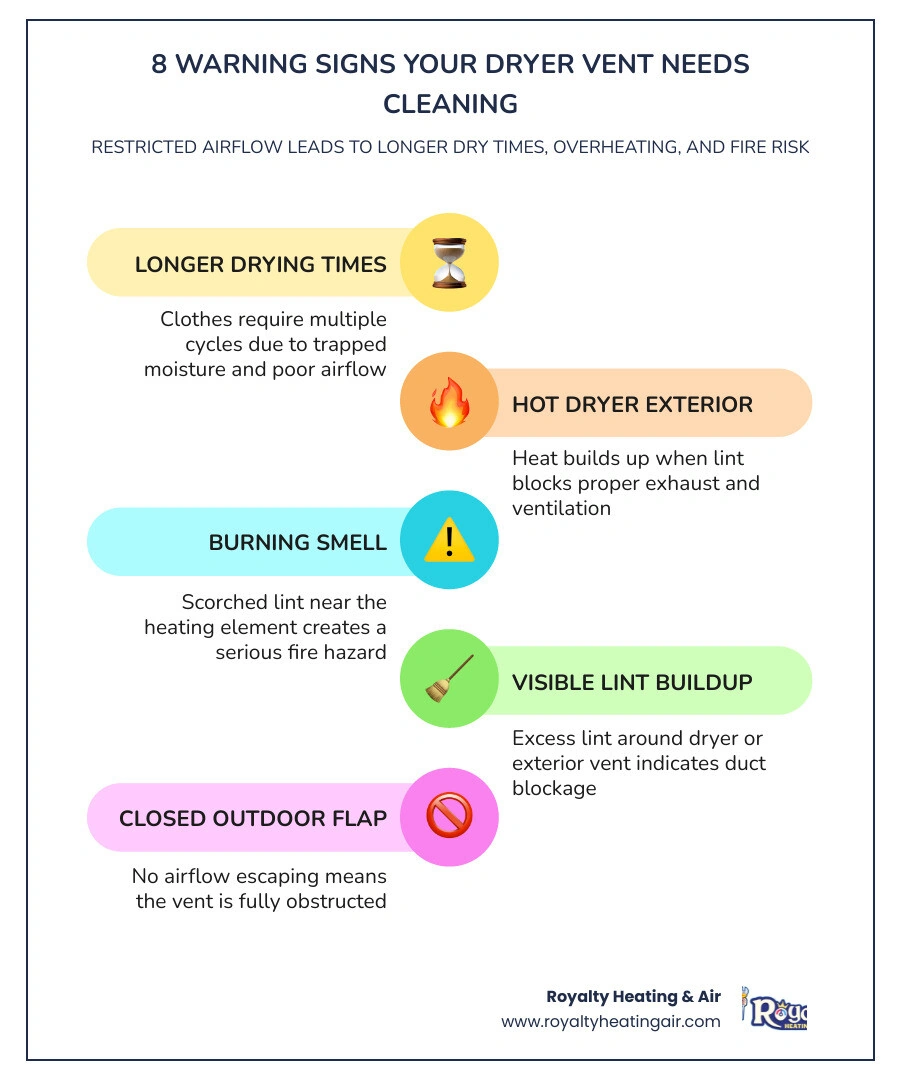
1. Clothes take more than one cycle to dry — restricted airflow traps moisture in the drum
2. The dryer or laundry room feels unusually hot — heat has nowhere to escape
3. You notice a burning smell during a cycle — lint near the heating element may be scorching
4. Lint is piling up behind the dryer or around the exterior vent — a sign the duct is backing up
5. The outdoor vent flap stays closed while the dryer runs — little to no airflow getting through
6. Freshly dried clothes smell musty — moisture is not exhausting properly
7. Your dryer shuts off mid-cycle — the unit is overheating and triggering a safety cutoff
8. It has been over a year since your last professional cleaning — buildup is likely significant
Most people clean the lint trap and assume the job is done. But according to the U.S. Fire Administration, failure to clean is the leading cause of dryer fires — accounting for 31% of all residential dryer fire ignition factors tracked from 2018 to 2020. The lint trap only catches a portion of what passes through your dryer. The rest travels deeper into the vent duct, where it compacts over time, restricts airflow, and creates a real fire hazard inside your walls.
For busy homeowners in Roseville managing a full laundry schedule, it is easy to dismiss a slightly longer drying time or a faint smell as a quirk of an aging appliance. In many cases, though, the dryer is not the problem — the vent behind it is.
Signs your dryer vent needs professional cleaning vocab to learn:
• dryer vent cleaning benefits and safety
• how clogged dryer vents cause house fires
• how dryer vent cleaning improves efficiency
When we think of fire hazards in our homes, we often focus on outdated electrical wiring, forgotten candles, or kitchen stoves. Yet, one of the most volatile ignition sources is sitting quietly behind your laundry room wall. Dryer lint is composed of tiny, highly combustible synthetic and cotton fibers shed by your clothes. Because it is incredibly fine and dry, it acts as perfect tinder.
National safety statistics paint a sobering picture of how dangerous neglected vents can be:
• Sobering Incident Rates: Clothes dryers and washing machines were responsible for an estimated 16,800 house fires in the U.S. in 2010, representing 4.5% of all residential structure fires.
• The Leading Cause: According to the U.S. Fire Administration (USFA), "failure to clean" is the single leading cause of dryer fires, accounting for 31% of all residential dryer fire ignitions.
• Devastating Annual Damage: The Consumer Product Safety Commission (CPSC) estimates roughly 15,500 residential dryer fires occur annually, resulting in approximately 10 deaths, 310 injuries, and more than $84 million in property damage.
• The Ignition Source: Lint is the direct ignition source in nearly 1 in 3 dryer fires, with 28% to 32% of dryer fires starting when lint, fiber, or dust comes into contact with the high heat produced by the appliance.
When your dryer vent becomes restricted, the hot air generated by the heating element cannot escape. The temperature inside the dryer cabinet continues to climb, eventually reaching a threshold where the compacted lint inside the ductwork can ignite. Because these vents are routed through walls, attics, or crawl spaces, a fire starting inside the duct can spread rapidly to the home’s wooden framing before smoke alarms even detect it.
To learn more about the physical mechanics of this process, read our detailed article on How Clogged Dryer Vents Cause House Fires.
Your dryer is designed to exhaust hot, moisture-laden air outside your home. When that pathway is blocked, the appliance tries to warn you through several noticeable performance drops. Recognizing these red flags early can save you from a major safety hazard and protect your appliance from premature breakdown.
Beyond the basic warning signs, pay close attention to how your laundry room feels and smells. If your laundry space suddenly feels like a humid tropical greenhouse every time you run a load, or if your clean clothes come out smelling damp and musty instead of fresh, moisture is being trapped inside the drum. This trapped humidity is the perfect breeding ground for mold and mildew inside your ductwork and laundry area.
For a comprehensive checklist on maintaining your entire exhaust system, consult our Ultimate Dryer Vent Cleaning Guide.
The most common and reliable indicator of a blocked exhaust line is a sudden increase in drying times. If a normal, mixed load of laundry that used to take 40 minutes now requires 60, 80, or even multiple drying cycles to get completely dry, your vent is likely choked with lint.
When airflow is restricted, the moist air evaporated from your wet clothes cannot escape the dryer drum. Instead, the damp air keeps recirculating, forcing the dryer to work twice as hard to achieve the same results. In testing, dryers with restricted ducts ran 20 to 30 minutes longer per load, adding up to 150 extra run hours annually for an average household.
This extra operation does not just waste your Saturday afternoon; it has a direct impact on your wallet. A clogged dryer vent can increase energy consumption by up to 30% because the heating elements must run constantly to compensate for the lack of airflow. If you want to know how proper maintenance keeps your utility bills in check, read about How Dryer Vent Cleaning Improves Efficiency.
If you ever detect a burning or scorched-fabric smell while your dryer is running, treat it as an immediate safety emergency. This odor occurs when the internal temperature of the dryer cabinet gets high enough to scorch the lint accumulating near the heating element.
If you smell burning:
1. Stop the cycle immediately.
2. Unplug the appliance or shut off the gas valve.
3. Do not attempt to run the machine again until a professional has inspected and cleaned the entire vent system.
In addition to unusual smells, the exterior cabinet of your dryer or the clothes themselves should never feel blazing hot to the touch at the end of a cycle. If the metal top of your dryer feels hot enough to burn your hand, or if metal zippers on your jeans are too hot to touch, the system is overheating. This extreme heat damages fabric fibers, ruins elastic, and shortens the lifespan of your appliance from a standard 10–13 years down to just 5–7 years.
If your system is running hot, refer to our guide on how to safely Clean Dryer Vents.
A quick walk around the exterior of your home is one of the easiest ways to check the health of your exhaust system. Locate your exterior dryer vent hood and observe it while the dryer is running.
The vent hood is equipped with a backdraft damper—a small flap or set of louvers designed to open under the pressure of exhausting air and close tightly when the dryer is off. If the flap barely moves or stays completely closed while the machine is running, there is not enough airflow passing through the line to push it open.
Conversely, if the flap is stuck permanently open, it is often because a thick mat of lint has built up around the edges, preventing it from closing. A stuck-open vent flap is an open invitation for pests. In Loomis, Rocklin, and Roseville, CA, we frequently find bird nests, rodents, and insects setting up camp inside warm dryer ducts. This completely blocks the vent and introduces biological hazards into your home's air.
If you notice lint spilling out of your exterior vent cap, or if you see physical debris blocking the opening, it is time to seek out a Local Dryer Vent Cleaning professional who can clear the blockage from end to end.
Many homeowners ask us: "If I clean my lint screen after every single load, why do I still need a professional to clean the vent duct?"
The answer lies in the limitations of your dryer's internal design. The removable lint screen is only designed to intercept about 75% to 80% of the lint generated during a cycle. The remaining 20% to 25% consists of micro-fibers that are small enough to slip through the mesh screen. These fibers bypass the trap and enter the internal blower wheel, the transition duct behind the machine, and the rigid metal ductwork running through your walls.
While a homeowner can easily clean the lint screen and vacuum out the immediate transition hose directly behind the dryer, they lack the specialized tools required to clean deep, hidden duct runs. Standard residential dryer ducts can extend up to 35 feet, twisting through multiple 90-degree elbows before reaching the exterior wall or roof. Standard vacuum attachments cannot reach these deep bends, and cheap DIY wire brushes can easily get stuck, puncture flexible ducting, or pack the lint tighter into a solid, impassable clog.
Professional technicians use rotary brush systems powered by high-velocity vacuum equipment. These rotating brushes scrub the interior walls of the rigid metal duct, breaking loose stubborn, baked-on lint mats without damaging the pipe. Furthermore, professionals ensure your entire setup is code-compliant, checking that transition ducts are made of UL-listed materials rather than fire-prone plastic or thin foil.
• Area Cleaned — DIY Lint Trap Cleaning: Removable mesh screen & immediate housing slot — Professional Full Vent Duct Cleaning: Blower wheel, transition hose, full wall duct run, & exterior cap
• Tools Used — DIY Lint Trap Cleaning: Hands, soft brush, or standard vacuum attachment — Professional Full Vent Duct Cleaning: Rotary brushes, high-powered negative air vacuums, tension gauges
• Frequency — DIY Lint Trap Cleaning: After every single laundry load — Professional Full Vent Duct Cleaning: Every 12 months (or every 6 months for heavy-use homes)
• Major Benefit — DIY Lint Trap Cleaning: Prevents immediate lint buildup in the drum — Professional Full Vent Duct Cleaning: Eliminates deep wall fire hazards & restores optimal system airflow
• Code Inspection — DIY Lint Trap Cleaning: None — Professional Full Vent Duct Cleaning: Verifies proper duct materials, length, and termination compliance
Regularly taking the time to Clean Dryer Lint Trap mesh is a fantastic daily habit, but it must be paired with professional duct maintenance to keep your home completely safe.
To help you keep your laundry room running safely and efficiently, we have answered some of the most common questions we receive from homeowners in Roseville, Rocklin, and Lincoln, CA.
For the average household, we recommend having your dryer vent professionally cleaned at least once a year. However, this frequency depends heavily on your specific household size and usage habits:
• Large Families: If you run more than 5 loads of laundry per week, lint accumulates much faster. You should consider cleaning the vent every 6 to 9 months.
• Pet Owners: Pet hair and dander easily bypass the standard lint screen, creating thick, sticky clogs inside the ductwork. Homes with multiple shedding pets require semi-annual cleanings.
• Long Vent Runs: If your dryer vent has a long path to the roof or an exterior wall with multiple bends, air moves slower through the pipe, allowing lint to settle and build up quickly.
The safest, code-compliant material for a dryer exhaust system is rigid metal ducting (usually aluminum or galvanized steel) with a smooth interior wall. Smooth walls prevent lint from catching on ridges, ensuring maximum airflow and minimal accumulation.
You should avoid:
• Plastic or Vinyl Ducts: These are highly flammable, trap lint easily, and are banned by modern building codes.
• Flexible Foil Ducts: While common for transition pieces, cheap, unrated foil ducts sag easily, creating low points where moisture and lint collect.
For the transition duct (the piece connecting the back of your dryer to the wall outlet), always ensure you are using a UL 2158A-listed semi-rigid metal transition duct, kept as short and straight as possible.
You can perform a basic inspection yourself using these three steps:
1. The Airflow Test: Turn on your dryer on a high-heat cycle. Go outside to the termination hood and place your palm near the opening. You should feel a strong, warm, steady stream of air similar to a hair dryer. If the air feels weak, cool, or barely moving, there is a blockage.
2. The Flap Inspection: While the dryer is running, confirm that the louvers or flap on your exterior vent cap open fully. If they remain closed or only flutter slightly, airflow is restricted.
3. The Visual Check: Pull the dryer away from the wall (unplug it first!). Inspect the flexible transition duct behind the machine. If it is crushed, kinked, or clogged with visible lint, it needs immediate attention.
Paying attention to the signs your dryer vent needs professional cleaning is one of the simplest ways to protect your home, lower your energy bills, and keep your appliances running like new. From extended drying times to unusually hot cabinets and stuck exterior flaps, your dryer will always let you know when it is struggling to breathe.
At Royalty Heating & Air, we are proud to provide expert ductwork and ventilation services to our neighbors in Roseville, Rocklin, Loomis, Lincoln, and Granite Bay, CA. Beyond delivering top-tier comfort and technical expertise, we are a company driven by a deeper purpose: our partnership with the MackAttack Foundation allows us to support foster babies and sponsor beautiful family adoptions across our local communities.
When you schedule your maintenance with us, you are not just securing peace of mind and cleaner indoor air for your family—you are helping us build a warmer, safer future for children in need.
If you suspect your dryer vent is overdue for a deep clean, do not wait for a performance drop to turn into an emergency. Schedule Professional Duct Services with Royalty Heating & Air today.
