
Services
About
Service Areas


Getting the right size HVAC for the Sacramento area homes is one of the most important decisions you'll make as a homeowner — and one of the easiest to get wrong. Here's a quick overview of what proper sizing requires:
Quick Answer: How to Get the Right HVAC Size for Your Sacramento Home
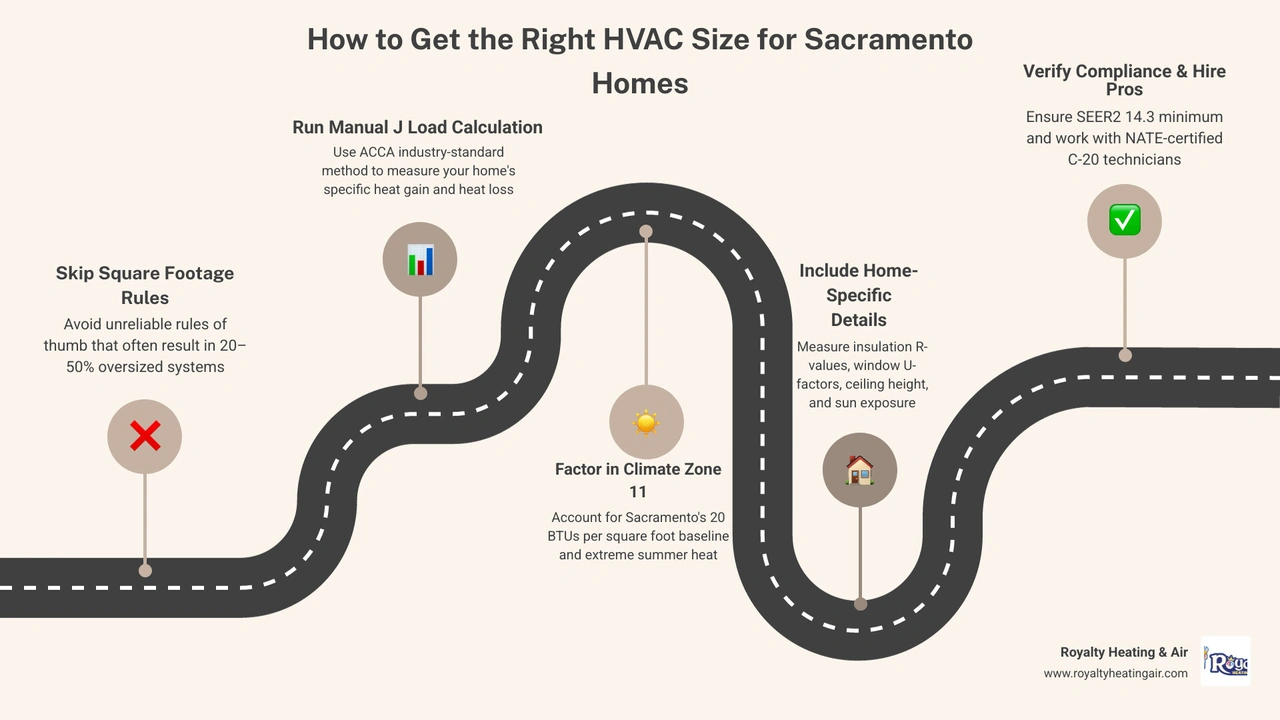
1. Skip the guesswork — square footage rules of thumb are unreliable and often result in systems that are 20–50% oversized
2. Get a Manual J load calculation — this is the ACCA industry-standard method that accounts for your home's specific heat gain and heat loss
3. Factor in Sacramento's Climate Zone 11 — the baseline is approximately 20 BTUs per square foot, higher than many other regions
4. Account for home-specific details — insulation R-values, window U-factors, ceiling height, sun exposure, and home orientation all affect the final number
5. Choose the right system type — central air, heat pump, or ductless mini-split each size differently
6. Verify SEER2 compliance — California requires a minimum of 14.3 SEER2 for new residential systems
7. Work with a licensed professional — a NATE-certified technician with a California C-20 license should run the calculation and perform the installation
Sacramento's summers are no joke. July averages 93°F, heatwaves routinely hit 100–110°F, and the season stretches nearly four months. On top of that, the region's famous Delta Breeze can drop temperatures by 20–30 degrees in just a few hours — and wildfire smoke has become a real air quality concern every year. Standard sizing rules built for mild climates simply don't hold up here.
The stakes are high. Up to 90% of HVAC systems are improperly sized or installed, according to industry data. An oversized unit cools the air fast but leaves your home feeling clammy and humid. An undersized one runs nonstop and still can't keep up on a 105°F afternoon. Either way, you're looking at higher energy bills, more repairs, and a system that wears out years too soon.
This guide walks you through everything Sacramento-area homeowners need to know to get the sizing right the first time.
When it comes to heating and cooling, many homeowners assume that "bigger is always better." If a 3-ton air conditioner keeps your neighbor’s house cool, a 4-ton unit must be a dream for yours, right?
In reality, this is one of the most expensive mistakes you can make. The old rule of thumb—such as allocating "one ton of cooling capacity per 500 square feet"—is a relic of the past. It assumes every home is built exactly the same, has the same insulation, and experiences the same climate.
In the Sacramento Valley, our local climate is classified as Climate Zone 11. This zone demands a unique approach to thermal performance. While a home in a mild coastal area might get by on minimal cooling capacity, a home in Roseville, Rocklin, or Lincoln requires a robust system engineered for intense, dry summer heat. However, modern construction and energy-efficient retrofits mean that a well-insulated home may actually require a much smaller system than you expect. Running a simple square footage estimate can easily lead to a system that is 20% to 50% oversized.
To understand why this is a problem, we have to look at how heating and cooling capacities are measured. HVAC systems are rated in British Thermal Units (BTUs) and tons. One ton of cooling capacity equals 12,000 BTUs per hour. If your home has a baseline requirement of 20 BTUs per square foot, a 1,500-square-foot ranch home in Roseville might need approximately 30,000 BTUs (or a 2.5-ton system). But if that home has been retrofitted with high-efficiency windows and modern insulation, its actual cooling load might be significantly lower.
Before you invest in a new system, it is vital to know When Should You Replace Your AC in the Valley. Replacing an old, failing unit with the exact same size without doing a modern load calculation often locks you into another 15 to 20 years of efficiency losses.
• Oversized — Run Cycle Behavior: Short cycles (runs for 5–8 minutes, shuts off) — Indoor Comfort & Humidity: Cold but damp, clammy air; uneven temperatures — Energy Bills: High (due to constant start-up energy spikes) — Equipment Lifespan: Shortened (accelerated wear and tear on compressor)
• Undersized — Run Cycle Behavior: Runs continuously on hot days — Indoor Comfort & Humidity: Hot, stuffy rooms; fails to reach thermostat set point — Energy Bills: High (continuous power draw) — Equipment Lifespan: Shortened (system operates under constant strain)
• Perfectly Sized — Run Cycle Behavior: Steady 10–15 minute cycles — Indoor Comfort & Humidity: Even, crisp cooling; excellent dehumidification — Energy Bills: Optimized (runs at peak efficiency) — Equipment Lifespan: Maximized (lasts 15 to 20 years with proper care)
Installing the wrong size HVAC system in Northern California’s Climate Zone 11 leads to immediate performance and comfort issues. Let's look closely at how oversized and undersized systems fail under real-world conditions.
An oversized air conditioner has too much power for the space it serves. When the thermostat calls for cooling, the system kicks on, blasts a massive volume of cold air into the home, and satisfies the thermostat in just 5 to 7 minutes. This is called short cycling.
While a fast cooling cycle might sound convenient, it is a disaster for your home's indoor air quality and mechanical components. A healthy cooling cycle needs to last at least 10 to 15 minutes. During this time, the evaporator coil gets cold enough to pull moisture out of the air, draining it safely outside. If your system runs for only 5 minutes, it shuts off before it can dehumidify. The result is a cold, damp, and clammy indoor environment that is highly susceptible to mold growth.
Furthermore, the start of an HVAC cycle is when the system consumes the most electricity and experiences the most mechanical strain. Short cycling forces your compressor to start up and shut down dozens of times a day, skyrocketing your utility bills and wearing out key components prematurely.
An undersized system is the opposite problem. On a typical 103°F afternoon in Rocklin or Lincoln, an undersized unit will turn on and simply never turn off. It runs continuously, hour after hour, straining to cool your home.
Because it lacks the BTU capacity to overcome the heat entering through your walls and windows, your home will remain uncomfortably warm. This constant operation results in massive energy bills and places immense mechanical strain on the fan motor and compressor. Like a small car trying to tow a heavy trailer up a steep mountain pass, the system will eventually overheat and suffer a catastrophic mechanical failure.
Understanding these risks highlights how crucial proper sizing is to the longevity of your investment. To learn more about what to expect from your system's lifetime, read our guide on How Long Does an AC Last in the Sacramento Valley.
To avoid these sizing traps, professional HVAC contractors use a standardized mathematical methodology called the Manual J load calculation. Developed by the Air Conditioning Contractors of America (ACCA), Manual J is the industry gold standard for calculating the precise heat gain (in summer) and heat loss (in winter) of a residential structure.
Instead of guessing based on square footage, a Manual J calculation acts as a complete thermal model of your home. It analyzes a wide range of structural and environmental variables, including:
• The exact geographic location and local outdoor design temperatures (95–98°F for the Sacramento area)
• The orientation of the home relative to the sun
• The surface area of all walls, ceilings, and floors
• Insulation values (R-values) in the attic, walls, and crawlspaces
• Window types, frame materials, and glazing (U-factors and Solar Heat Gain Coefficients)
• Expected occupancy (human bodies generate roughly 400 BTUs of heat per hour at rest)
• Heat-generating appliances and lighting
By inputting these metrics into specialized software, we can determine the exact cooling and heating loads of your home. This ensures that you get a system that operates at peak efficiency. For a deeper dive into the installation process and how we implement these calculations, check out our AC Installation Roseville CA Ultimate Guide.
Every home is unique, and several key structural factors dictate how much heat your home absorbs during a blazing hot valley afternoon.
Your home’s insulation acts as a barrier to heat transfer. Older homes in established areas of Roseville or Loomis might have original fiberglass batts with low R-values, while a newer build in Granite Bay might feature modern spray-foam insulation. A well-insulated home retains conditioned air far better, allowing for a smaller, highly efficient HVAC unit. If your home has significant air leaks or degraded insulation, it will have a much higher cooling load. Addressing these thermal envelope issues first can often allow you to downsize to a smaller, less expensive HVAC system.
Windows are the weakest link in your home's thermal envelope. Large, single-pane windows—especially those facing south or west—can act like a greenhouse, pouring heat into your living spaces. When performing a Manual J calculation, we look at the window area, the direction they face, and whether they have low-E coatings or shading from mature trees. Upgrading to double-pane, low-E windows can reduce your home's cooling load by up to 10%, directly impacting the size of the HVAC system you need.
To see how these efficiency upgrades work hand-in-hand with system sizing, read about Energy Efficient HVAC Systems Granite Bay CA.
Standard HVAC calculations often assume standard 8-foot ceilings. However, many homes in Lincoln and Granite Bay feature vaulted ceilings or grand 10-to-12-foot entryways. High ceilings significantly increase the total volume of air in a room. Because hot air rises, rooms with high ceilings require a specialized air distribution strategy and up to 25% to 30% more cooling capacity to keep the living zone comfortable.
Sacramento’s microclimates present unique challenges that must be factored into system selection and sizing.
• Triple-Digit Heatwaves: Most standard residential air conditioners are engineered to operate optimally up to an outdoor temperature of 95°F. When our local temperatures spike to 105°F or 110°F, standard single-stage systems can struggle. Sizing must account for these extreme heat events without oversizing the system for the rest of the year.
• The Delta Breeze: In the late afternoon and evening, a cool marine air current known as the Delta Breeze often sweeps through the valley, dropping temperatures by up to 30 degrees in a matter of hours. This rapid shift makes variable-speed systems highly desirable. A variable-speed compressor can scale down its capacity to match the cooler evening air, maintaining perfect indoor comfort without short cycling.
• Wildfire Smoke and Air Quality: Northern California experiences regular wildfire seasons, making indoor air filtration a top priority. High-efficiency filters, such as MERV 13 filters, are essential for removing fine smoke particles. However, these thick filters create high static pressure, which restricts airflow. When sizing your HVAC system, we must ensure the blower motor is powerful enough to handle high-efficiency filtration without overheating or reducing system capacity.
For comprehensive strategies on keeping your indoor air clean during smoke events, read our guide on HVAC Air Purification.
Once we know your home's thermal load, we must select and size the right type of HVAC system to deliver that comfort.
Traditional central split systems use a single outdoor condenser paired with an indoor evaporator coil and furnace, distributing air through a network of ductwork. Sizing a central system requires matching the total tonnage of the outdoor unit to the total load of the home.
Modern heat pumps are rapidly replacing traditional central air and furnace setups. Heat pumps provide both heating and cooling by transferring heat rather than creating it, operating at up to 300% efficiency. Sizing a heat pump requires careful balancing to ensure it can handle our hot summers while still providing efficient heating during chilly winter nights. Discover the full range of options in our Heat Pump Benefits for Sacramento Area Homeowners.
When deciding on a system design, homeowners often choose between traditional central air and ductless mini-split systems. Sizing these two options requires entirely different approaches.
With a central air system, you are sizing a single unit to cool the entire house at once. This can sometimes lead to uneven temperatures, especially in multi-story homes where heat naturally rises to the upper levels.
Ductless mini-splits, on the other hand, allow for zoned comfort. Instead of one large central unit, a mini-split system utilizes smaller indoor air handlers installed in individual rooms or zones, all connected to a single outdoor compressor. This means we size each indoor unit specifically for the room it serves. A guest bedroom might only need a small 6,000 BTU wall unit, while a large living room with vaulted ceilings might require a 15,000 BTU head. This targeted sizing eliminates energy waste in unoccupied rooms and provides highly precise comfort control.
To weigh your options, read our detailed comparison of Central Air vs Mini Split for the Sacramento Area Homes and explore our comprehensive Heat Pump Guide Roseville CA.
Even if you calculate the perfect equipment size using a Manual J calculation, your system will fail to perform if your ductwork is poorly designed, leaky, or undersized.
Ductwork acts as the circulatory system of your HVAC unit. If you install a new 3-ton heat pump but connect it to ductwork designed for an old 2-ton system, the restricted airflow will choke the system. This creates high static pressure, which can cause the evaporator coil to freeze, overheat the blower motor, and drastically reduce operating efficiency. In fact, leaky or poorly sized ducts can waste more than 20% to 30% of your system's conditioned air before it ever reaches your living spaces.
In California, compliance with Title 24 energy standards is legally required for most HVAC replacements. This includes professional duct leakage testing by a certified Home Energy Rating System (HERS) rater to ensure your system meets strict efficiency guidelines.
When planning an upgrade, especially in older neighborhoods, professional installation is key. Check out our AC Installation Rocklin CA Tips 2025 and our Best Heat Pump Roseville CA Guide to ensure your installation meets all local codes and operates at peak performance.
• Oversized Signs: Your system turns on and off every 5 to 8 minutes (short cycling), the indoor air feels cold but damp or humid, you notice significant temperature swings between rooms, or your utility bills are unusually high.
• Undersized Signs: On hot summer days, the system runs continuously without ever reaching your thermostat’s set temperature, air coming from the vents feels weak or lukewarm, and your energy bills spike due to non-stop operation.
While a basic equipment swap-out doesn't always trigger a mandatory Manual J filing in every municipality, California’s Title 24 energy code heavily encourages it. For any major home remodel, room addition, or new construction in Roseville, Rocklin, and surrounding areas, a documented load calculation is legally required to secure building permits.
Standard BTU calculators assume a standard 8-foot ceiling. Vaulted, cathedral, or 10-to-12-foot ceilings significantly increase the volume of air in a room. Because heat rises, a room with 12-foot ceilings can require 25% to 30% more cooling capacity (BTUs) to maintain comfortable temperatures in the lower living zone.
Getting the right size HVAC system is the single most important factor in ensuring your home remains a comfortable haven during our intense Sacramento Valley summers. By skipping the outdated rules of thumb and trusting a scientific Manual J load calculation, you protect your home from the efficiency losses, high utility bills, and early system breakdowns caused by improper sizing.
At Royalty Heating & Air, we provide expert, NATE-certified HVAC installation, repair, and maintenance services across Roseville, Rocklin, Lincoln, Loomis, and Granite Bay. We are deeply committed to doing the job right the first time, ensuring your system is sized perfectly for your home's unique layout and local climate.
Beyond keeping your family comfortable, we believe in supporting our local community. Through our partnership with the MackAttack Foundation, we proudly support foster babies and sponsor family adoptions, bringing comfort and joy to children and families in need.
Don't leave your summer comfort to guesswork. Schedule your professional HVAC sizing consultation with Royalty Heating & Air today and experience the peace of mind that comes with a perfectly sized home comfort system!
