
Services
About
Service Areas


Furnace repair vs replacement when to decide is one of the most stressful choices a Roseville homeowner can face — especially when the temperature drops and your heating system starts acting up. The wrong call can cost you thousands of dollars, either in repeated repair bills or in an unnecessary early replacement.
Here is a quick-reference guide to help you decide right now:
Repair your furnace if:
• Your furnace is under 10 years old
• The repair is minor (ignitor, flame sensor, thermostat)
• You have had only one breakdown this season
• The repair cost is well under 50% of a new system's price
Replace your furnace if:
• Your furnace is 15 years old or older
• You have had multiple breakdowns in the past 1-2 seasons
• The repair cost is 50% or more of a new furnace's price
• Your furnace age multiplied by the repair cost exceeds $5,000
• You have a cracked heat exchanger or carbon monoxide concern
Most homeowners in Roseville do not realize how much an aging, inefficient furnace is quietly costing them every month in wasted energy — on top of the repair bills. And when Sacramento Valley temperatures dip in winter, a furnace failure is not just uncomfortable, it is a real problem.
In this guide, we walk you through every factor that matters: furnace age, breakdown patterns, efficiency ratings, major component failures, safety risks, and the proven financial rules of thumb that HVAC professionals use every day.
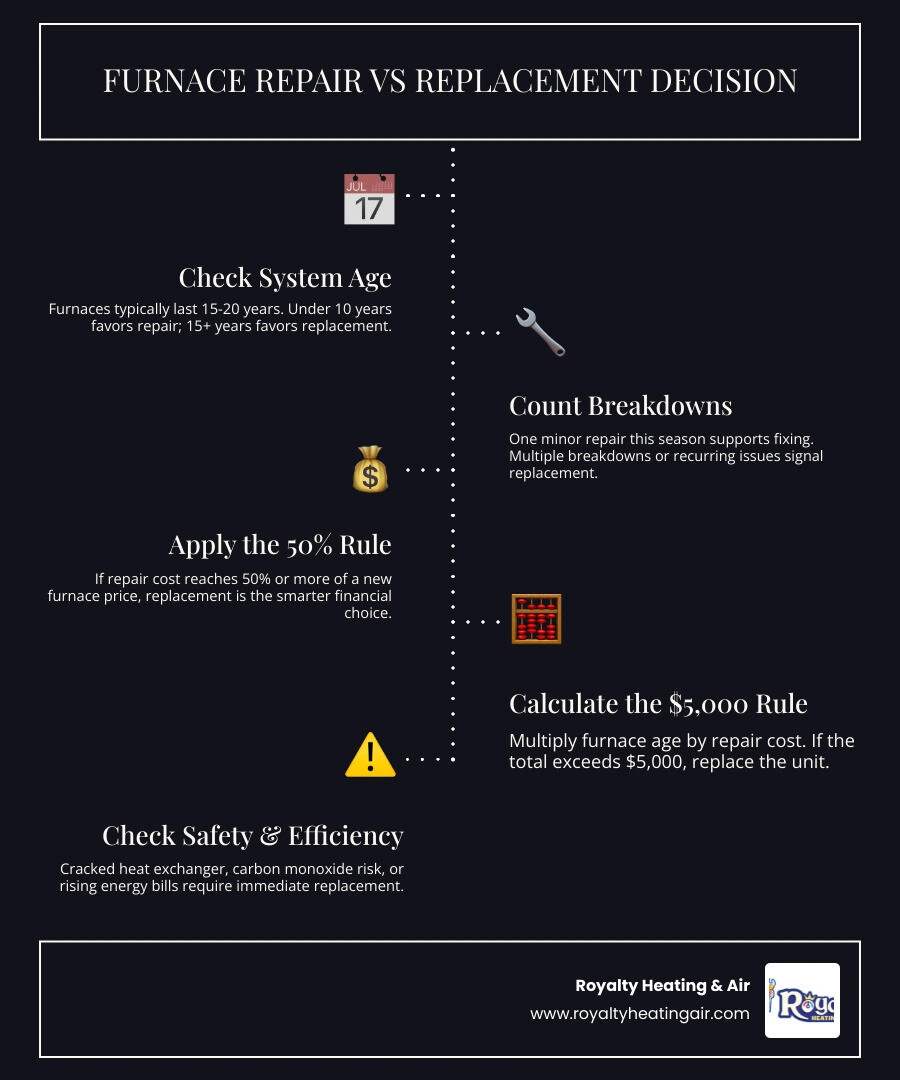
When your heating system begins to falter, it rarely does so with a polite written warning. Usually, it starts with an unsettling rattle in the middle of a cold January night, or a sudden, unexplained spike in your monthly utility bill. At that moment, you find yourself standing in front of your utility closet, wondering: Do I call for another quick fix, or is it time to invest in a brand-new system?
Deciding on furnace repair vs replacement when to decide is fundamentally a balance of safety, operational reliability, and financial strategy. A heating system is a complex machine, and while some issues are simple to resolve, others point to systemic wear that no amount of maintenance can truly fix.
To make an educated decision, you must look beyond the immediate breakdown. You have to evaluate how the system is performing overall, how often it leaves you shivering, and whether the machinery itself is still safe to operate. For a deeper dive into how these factors interact across your entire heating and cooling setup, you can read our guide on When to Repair vs Replace Your HVAC System.
The very first piece of data you need to check is your furnace’s age. Most residential gas furnaces have an expected operational lifespan of 15 to 20 years. However, how long a system actually lasts depends heavily on its maintenance history and the climate it operates in.
Here in the Sacramento Valley, our winters are relatively short but can be incredibly damp and chilly. While our systems do not run continuously for six months like they might in the Midwest, the rapid transition from hot summers to cold winters puts unique expansion and contraction stress on the metal components of your furnace.
If your furnace is under 10 years old, it is almost always worth repairing unless it has suffered catastrophic, neglected damage. Between 10 and 15 years, you are in a transitional zone where the type of repair and the efficiency of the unit will dictate your choice. Once a furnace crosses the 15-year threshold, its internal components are nearing the end of their engineered life. At this stage, investing in major repairs often yields diminishing returns. To help you determine where your current unit stands on this timeline, explore our analysis of How Old Is Too Old for an HVAC System.
Think of your furnace like an old car. If you have to replace a minor belt once every few years, that is normal wear and tear. But if you find yourself on a first-name basis with your local HVAC technician because they are at your house every other month, you are dealing with a reliability crisis.
Frequent breakdowns are a clear warning sign that the system is structurally failing. Common signs of a dying furnace include:
• Short cycling: The furnace turns on and off rapidly without ever reaching the temperature set on your thermostat.
• Uneven heating: Some rooms feel like a sauna while others remain drafty and freezing.
• Strange noises: Squealing, banging, or rattling sounds indicate loose or failing mechanical parts.
• Persistent ignition issues: The system struggles to start or repeatedly locks itself out for safety.
If you are calling for emergency service calls multiple times during a single winter season, those individual repair bills quickly add up to a substantial sum. More importantly, a system that breaks down repeatedly cannot be trusted to keep your family safe during a severe cold snap. If this sounds familiar, your system is likely sending you signals that it is time for an upgrade. You can learn more about these warning signs in our article on Signs Your HVAC Needs Replacing Not Just Fixing.
When emotion and the stress of a cold home threaten to cloud your judgment, turning to objective mathematical formulas can bring much-needed clarity. Deciding whether to repair or replace is ultimately a financial decision. You want to make sure you are placing your hard-earned money where it will deliver the best long-term value, safety, and comfort.
To help visualize the general path forward, consider this comparison table of repair vs. replacement indicators:
• System Age — Favor Repair: Under 10 years — Favor Replacement: Over 15 years
• Repair Frequency — Favor Repair: Rare, isolated incidents — Favor Replacement: Multiple times per season
• Safety Status — Favor Repair: Completely safe; minor wear — Favor Replacement: Cracked heat exchanger / CO risk
• Utility Bills — Favor Repair: Stable and predictable — Favor Replacement: Steadily climbing
• Formula Results — Favor Repair: Passes 50% and $5,000 rules — Favor Replacement: Fails 50% or $5,000 rules
By comparing these indicators, you can get a clearer picture of your system's health. For a comprehensive look at how these financial dynamics play out over the years, check out our guide on the Cost of Repairing Old HVAC vs Buying New System.
The 50% Rule is a straightforward economic threshold used throughout the HVAC industry. It states that if the cost of a single repair is 50% or more of the cost of a brand-new system, you should opt for replacement.
This rule is particularly powerful because it prevents homeowners from falling into the "sunk cost" trap. It is incredibly tempting to think, "Well, if I just pay for this one major repair, the system will last another five years." Unfortunately, on an older furnace, fixing one expensive component does not stop the other aged parts from failing next month.
When you apply the 50% rule, you are comparing a temporary patch on an old, out-of-warranty system against a complete, reliable upgrade backed by a fresh manufacturer's warranty. For more guidance on recognizing when your system has crossed this point of no return, read our article on Indicators Time for Furnace Replacement.
Another highly reliable mathematical framework is the $5,000 Rule. This rule is incredibly simple to calculate:
Furnace Age (in years) × Cost of the Proposed Repair
If the resulting number is under $5,000, repairing the unit is generally considered a reasonable investment. If the result is over $5,000, the math strongly suggests that replacing the furnace is the smarter financial decision.
Let's look at two quick examples to see how this works in practice:
1. Scenario A: You have an 8-year-old furnace that needs a repair. The math is: 8 years × Repair Cost = Result well under the $5,000 threshold. In this case, proceeding with the repair makes excellent financial sense because the system still has plenty of useful life ahead.
2. Scenario B: You have a 15-year-old furnace that needs a moderate repair. The math is: 15 years × Repair Cost = Result that exceeds the $5,000 threshold.Even though the repair itself might not seem incredibly expensive on its own, multiplying it by the advanced age of the system proves that you are investing money into a system with very little remaining life.
Using these objective calculations helps strip the anxiety out of the decision-making process. If you want to understand how these formulas factor into modern system upgrades, take a look at our Furnace Replacement Cost Estimate 2025 resource.
While financial formulas provide excellent guidance, there are times when performance, efficiency, and safety must override everything else. A furnace is not just a comfort appliance; it is a combustion system that burns fuel inside your living space. Therefore, physical warning signs and safety hazards must be taken incredibly seriously.
If you live in an older home in Loomis, Rocklin, or Roseville, your furnace might be a standard-efficiency model from the early 2000s. These older units typically operate at around 80% AFUE (Annual Fuel Utilization Efficiency), meaning that 20% of the energy you pay for is lost directly up the flue vent. Some very old systems can even operate as low as 60% to 70% AFUE.
Modern high-efficiency furnaces achieve outstanding ratings between 90% and 97% AFUE. This means they convert nearly all the gas they consume into usable heat for your home.
If you notice that your winter energy bills are steadily climbing year after year, even though your heating habits have not changed, your older furnace is losing its efficiency. Upgrading to a modern system can drastically reduce your monthly utility costs, allowing the new system to partially pay for itself over time through energy savings.
There is one component in your furnace where a failure means an automatic decision to replace: the heat exchanger.
The heat exchanger is the metal chamber that contains the hot combustion gases. As air from your home passes over the outside of the heat exchanger, it warms up before being blown through your ducts. If this metal chamber develops even a microscopic crack due to years of expansion and contraction, it can leak toxic carbon monoxide (CO) directly into your home's breathing air.
A cracked heat exchanger is a severe safety hazard. If a technician discovers a crack during an inspection, they are legally required to disable the system to protect your family. Because replacing a heat exchanger is incredibly labor-intensive and expensive, finding a crack on an out-of-warranty system is almost always an immediate trigger for a furnace replacement.
Other critical safety indicators include:
• A yellow or flickering pilot light/burner flame: A healthy burner flame should always be a crisp, steady blue. A yellow flame indicates incomplete combustion, which produces high levels of carbon monoxide.
• Soot buildup: Dark carbon deposits around the furnace burners or vents.
• Frequent carbon monoxide detector alarms: Never ignore a CO alarm; shut down your system and call for help immediately.
For practical advice on identifying and addressing these common issues before they become dangerous, see our guide on how to Identify Address Common Furnace Repair Issues.
Beyond the numbers and the mechanics, there are several practical, real-world factors that should influence your choice. Your long-term plans for your home, the current season, and the availability of parts all play a major role in determining the path of least resistance.
Before you authorize any major work, always check your furnace’s warranty status. If your system is still covered under a manufacturer's parts warranty, even a major component failure might only cost you the price of labor, making a repair highly attractive.
However, if your system is old and out of warranty, you are responsible for the full cost of both parts and labor. Additionally, as furnaces age past 15 years, manufacturers stop producing replacement parts. This can lead to "parts obsolescence," where a simple broken component requires a weeks-long wait for a specialty order. If your furnace breaks down during a cold stretch in Lincoln or Granite Bay, waiting weeks for a part is simply not a viable option. If you are currently dealing with a system that refuses to start, you can troubleshoot the initial signs using our guide on Furnace Not Igniting.
When making your final decision, consider your future plans for your property. If you plan to sell your home in the next year or two, a minor repair might be the most practical way to keep the home comfortable. However, keep in mind that an old, outdated heating system can be a major red flag for home buyers during inspections. Upgrading to a new system can boost your home's marketability and value.
On the other hand, if you plan to stay in your home for the long haul, investing in a new system provides:
• Consistent comfort: Modern systems utilize variable-speed blowers to eliminate cold spots.
• Advanced features: Compatibility with smart thermostats, zone control, and whole-home air purification systems.
• Peace of mind: Knowing your heating system is safe, reliable, and covered by a brand-new 10-year warranty.
For our neighbors in the Sacramento Valley, balancing your heating and cooling needs is a year-round job. To understand how long these systems typically withstand our local climate, read our article on How Long Does an AC Last in the Sacramento Valley. For Roseville residents specifically, we have put together a dedicated resource: the Furnace Replacement in Roseville CA Guide.
With regular annual maintenance, a standard gas furnace typically lasts between 15 and 20 years. In milder climates like ours, well-maintained systems can sometimes push past the 20-year mark, but their operating efficiency will be significantly lower than modern units.
Yes, you can absolutely replace just your furnace while keeping your current air conditioning unit. However, if your AC is also nearing the end of its lifespan, replacing both systems at the same time is often highly recommended. Installing a matched system ensures maximum energy efficiency, seamless communication between components, and lower overall labor costs compared to doing the installations separately.
The heat exchanger is by far the most critical part of your furnace. It is responsible for keeping dangerous combustion byproducts separate from the air you breathe. Any compromise to the heat exchanger is a severe safety risk that requires immediate professional attention.
At Royalty Heating & Air, we believe in providing honest, straightforward guidance to our community. Deciding on furnace repair vs replacement when to decide shouldn't feel like a high-pressure sales pitch. Our team of certified technicians is dedicated to assessing your system thoroughly, explaining your options in plain language, and helping you make the choice that fits your family's comfort, safety, and budget.
Whether you are in Roseville, Rocklin, Loomis, Lincoln, or Granite Bay, we are here to help. Plus, when you work with us, you are supporting a larger mission. Through our proud partnership with the MackAttack Foundation, we support foster babies and sponsor family adoptions, bringing warmth and care to families in need across our region.
If your furnace is making strange noises, blowing cool air, or causing your energy bills to climb, do not wait for a complete winter breakdown. Contact us today to schedule a professional diagnostic or system evaluation.
